What Every Parent Needs to Know About Building a Savings Habit at Age 6
Six is the sweet spot. Your child finally understands that money buys things, can count to twenty without losing focus, and - most importantly - is forming the routines that will quietly run their adult life. A 2026 report from the Consumer Financial Protection Bureau confirmed what behavioral economists have been saying for years: most lifelong money habits are set between ages 6 and 9, before kids ever earn a real paycheck. If you wait until middle school to "have the money talk," you're not teaching habits - you're trying to overwrite them.
The good news: a savings habit at this age doesn't require an app, a spreadsheet, or a finance degree. It requires a jar, a routine, and a parent who shows up the same way every week. That's the whole secret. The rest of this guide is just the mechanics.
Here's what every parent should know before starting:
- A 6-year-old's "savings" is not really about the money - it's about practicing delayed gratification in a low-stakes setting
- Physical, visible savings beat digital tracking at this age - the brain isn't ready for abstract numbers yet
- Consistency matters far more than amount - $1 a week beats $10 once a month, every single time
- A clear, kid-chosen goal is the single biggest predictor of whether the habit sticks
- Rescuing your kid from an empty Spend jar is the fastest way to undo months of progress
- The ritual you build now is the actual product - the dollar amounts are almost beside the point
Before you start, think about:
- When your child gets money (allowance, gifts, found change) and how often
- Whether you want to tie saving to chores or keep it separate
- A consistent weekly time you can protect for the savings ritual
- A physical spot - visible, not hidden in a closet - for the savings jar
- One realistic short-term goal your child genuinely wants
- How you'll handle the moment your kid wants to break into the Save jar early (it will happen)
Done well, the first three months of this habit shape how your child thinks about money for the next thirty years. That's not hyperbole - it's how habit formation works in the developing brain.
Young Bucks Club helps families build money confidence with no-jargon guides and a free budgeting app. In this guide, we'll walk through the exact framework, the comparison between savings tools, the scripts that work in real kitchens, and how to keep the habit alive once the novelty wears off.
The Building Blocks of a Lasting Savings Habit at Age 6
Most parents try to teach saving the same way they teach math: explain the concept, hope it lands. That works for arithmetic. It does not work for habits. A 2026 longitudinal study from the University of Cambridge tracked children who started weekly savings rituals at age 6 versus age 10. By age 18, the early starters had saved 3.4× more on average - not because they earned more, but because the routine had been running quietly in the background for twelve years.
At six, your child is not learning about money. They're learning how to be around it. Every component of the habit - the jar's location, the day of the week, the words you use, the ritual of counting together - is doing real psychological work.
Building Block 1: Visual Reinforcement
A 6-year-old does not have the abstract reasoning to understand "you have $14.50 in your account." They do understand "the coins have filled up to the line on the jar." Visible progress is the engine of motivation at this age. The science here is well-established: dopamine spikes when we perceive movement toward a goal, and that spike is what makes us want to repeat the behavior tomorrow.
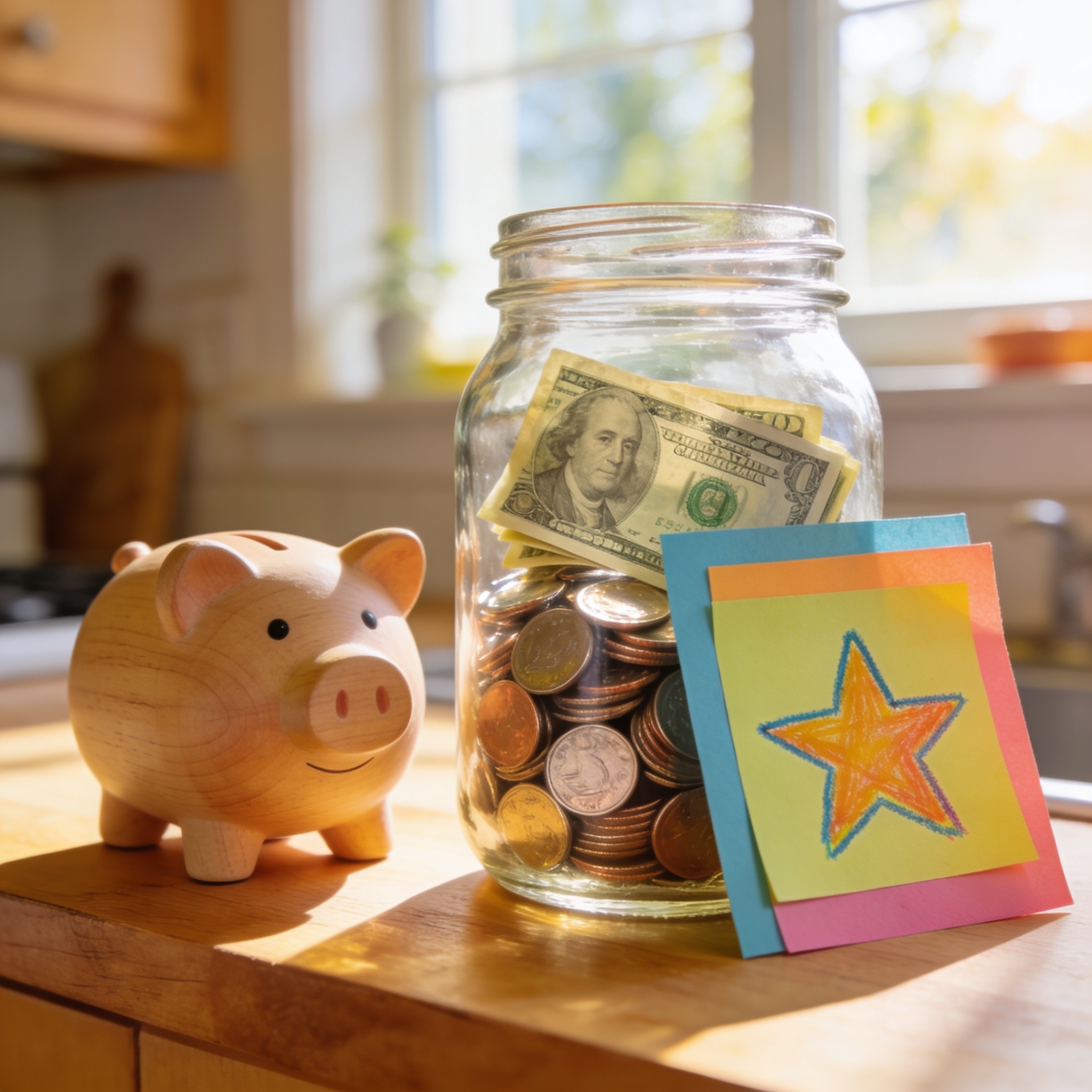
- Use a clear glass or plastic jar - visibility is the point
- Tape a picture of the savings goal directly to the jar
- Draw a line on the jar showing the target - kids can see the gap close
- Keep it in a high-traffic spot (kitchen counter, bookshelf) - out of sight is out of mind
If your child can walk past the jar and instantly see how close they are to the goal, the habit has a hundred small reinforcements per week. If the jar lives in a closet, you're relying on willpower - and a 6-year-old has very little of that to spare.
Building Block 2: Predictable Routines
Habits are formed by repetition under stable cues. The cue is what triggers the behavior - and for a 6-year-old, the cue should be external and concrete, not internal and abstract. "Saving on Sundays after pancakes" is a cue. "Save when you remember" is not.
A 2026 BuckBook user data report (drawn from over 40,000 family accounts) found that families who saved on the same day each week were 4× more likely to maintain the habit past month three than families who saved "whenever." The day of the week mattered less than the consistency itself - Sunday morning families and Friday evening families had near-identical success rates.
Practical translation: pick one day. Stick to it. The ritual you build into Sunday morning at age 6 is the same ritual your kid will fold into their adult financial life. It just gets bigger.
How to Choose the Right Savings System for a 6-Year-Old
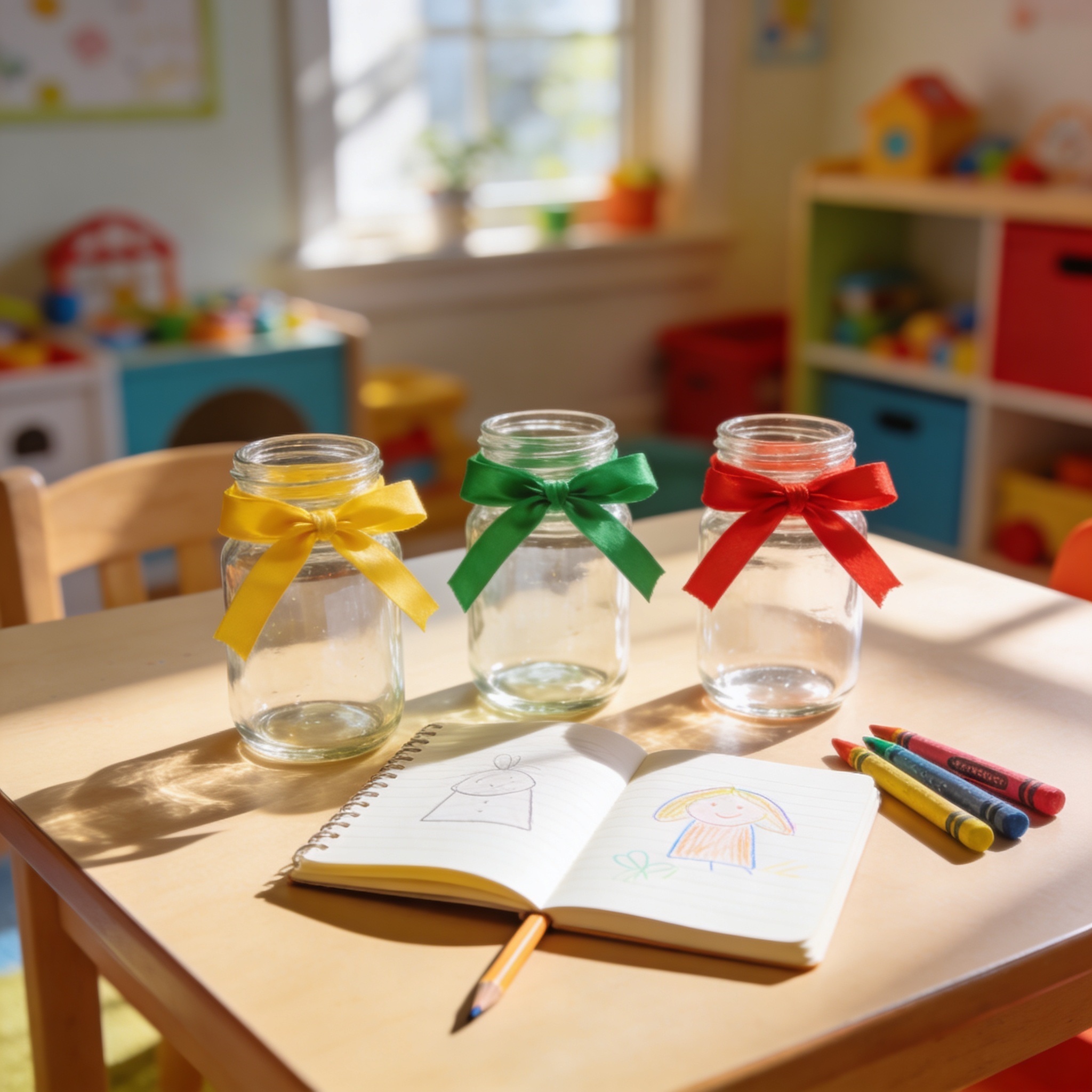
There are four main options for where a 6-year-old's savings actually live: a single clear jar, a multi-jar system (Spend / Save / Give), a traditional piggy bank, or a kid-focused digital app. Each one teaches something slightly different, and the right answer depends on your child's temperament and your family's pace.
| Tool | Teaches | Strengths | Best For |
|---|---|---|---|
| Single Clear Jar | Goal-focused saving | Lowest friction, one habit at a time | First-time savers, kids who get overwhelmed easily |
| 3-Jar System | Spend, save, give | Builds the full money mindset early | Kids ready for a slightly bigger system |
| Piggy Bank | Putting money away | Familiar, tactile, simple | Very young kids (4-5) just learning the concept |
| Kid Banking App | Digital tracking | Grows with the child, tracks history | Best as a complement to jars at age 6, not a replacement |
Expert tip: Most child development specialists recommend starting with a single clear jar at age 6, then expanding to the 3-jar system around age 7 once the basic ritual is locked in. Adding the Spend and Give jars too early can confuse a kid who hasn't yet internalized why we save at all. Start with one habit. Earn the right to add a second.
"What if my 6-year-old won't sit still long enough to save?"
This is the most common worry parents bring to us - and the answer is that the entire ritual should take 3 to 5 minutes, not thirty. If your savings session feels like a meeting, it's already too long for a 6-year-old's attention span. Here's what actually works:
- Keep it to 3 minutes. Set a visible timer if needed - kids love a countdown.
- Make the physical action the main event. Counting coins out loud, dropping them in, hearing the clink - those sensory moments are the lesson.
- Ask one - only one - question each week. "What's your goal again?" or "How close are we?" Don't lecture. They tune out by sentence three.
- End with a high-five and the question "Same time next week?" The closing ritual matters as much as the saving itself.
For families who want the methodology in a deeper, ready-to-implement format, our complete guide to the 3-Jar Method walks through the exact ratios, scripts, and graduation milestones from ages 5 through 11. It's the natural next step once your 6-year-old has a single jar working smoothly.
Visible Savings vs. Hidden Savings
Visible savings means a clear jar in the kitchen, the picture of the goal taped to it, the line that shows the target. Every glance reinforces the habit. The downside is that visible cash can also tempt impulse breaking - which, while painful, is itself a great learning moment.
Hidden savings means a piggy bank or a sealed envelope. It removes the temptation, but it also removes the daily reinforcement. For a 6-year-old, visible wins almost every time. The exception is the kid who genuinely cannot resist breaking in - for that child, a piggy bank with a slot but no easy opening can be a useful bridge until self-regulation catches up.
Savings Habits for Every Family Setup

There is no single family setup the savings habit needs to be designed around. What matters is matching the ritual to the rhythm of your week. Here's how the habit takes shape across the three most common family configurations:
- Single-child households - easiest to implement because the ritual gets the parent's full attention. Use this to your advantage: make the weekly savings session genuinely fun and one-on-one. It becomes a small piece of connected time your kid actually looks forward to.
- Multi-child households - each child gets their own jar with their own goal. Resist the urge to standardize amounts. Older siblings can save more from larger allowances; younger ones save proportionally less. Same ritual time, parallel jars.
- Co-parenting or blended families - keep the jar at one home (whichever feels like the "main base") and let the other parent reinforce the goal in conversation. Splitting the jar across houses dilutes the habit; pick one anchor and let the other parent be the cheerleader.
Three Tiers, from Zero-Cost to Full System
You don't need to buy anything to start. But if you want a more developed setup as the habit matures, here's how families typically layer in tools:
- Beginner (free): An empty pasta sauce jar, washed and dried. A printed picture of the goal taped to the front. A pen-drawn line at the target. Zero dollars, zero excuses.
- Intermediate ($10-$25): A purpose-built clear savings jar set with chalk-labeled lids. A small goal-tracker chart for the fridge. A countdown chart kids can sticker each week.
- Advanced (~$30 or app-based): A printable starter kit (jar labels, goal trackers, weekly check-in cards) paired with a kid-friendly app like BuckBook to begin logging savings digitally as a bridge to the 8+ age range.
Customizing the Ritual to Your Kid
A trend we're watching in 2026 - and one that families tell us is genuinely working - is moving away from rigid "rules" and toward kid-led customization. The basic structure stays the same, but the texture of the ritual gets personalized. Some adjustments worth trying:
- Reward style: some kids thrive on stickers and celebration; others prefer quiet acknowledgment. Match your kid's actual temperament, not parenting-book defaults.
- Deposit cadence: weekly works for most. Some families do "double Sundays" where any chore-earned money goes straight into the jar before the ritual even starts.
- Goal type: short-term goals (a $7 toy, two weeks) work better than long-term ones at age 6. Save the long-haul goals for ages 8+ when time horizons start to register.
Why Young Bucks Club Makes a Difference

If you've ever stood in the parenting section of a bookstore trying to find the right money book for a 6-year-old, you know the problem: most resources are either too abstract, too long, or built for older kids. The result is that most parents give up before they start. We built Young Bucks Club because that gap genuinely hurts families - and the gap is widest in the early years, exactly when habits matter most.
- Free BuckBook app - a kid-friendly savings tracker built for ages 5-15, with no ads aimed at children, ever
- No-jargon parent guides - written in real language, with real numbers, for real kitchens
- Family-account sync - so the savings ritual at home stays connected to the digital tracking when your kid is ready
- A friendly mascot, not a financial advisor - Buck is here to teach, not to sell. We exist for the families, not the banks.
Getting the Most Out of Your Child's First Savings Habit
A few small moves can dramatically increase the odds the habit sticks past month three - which is the danger zone where most family rituals quietly die.
- Make the first goal small enough to hit in 2-4 weeks. Early wins build the neural reward loop that keeps the habit going.
- Take a photo of the empty jar on day one, and another on goal day. The before/after is genuinely powerful for a 6-year-old to look back on.
- Let your child be the one to physically drop the coins in. Your hands stay out of the jar. This is their habit, not yours.
- When the first goal is hit, celebrate the process, not just the prize. "You stuck with it for four weeks" lands harder than "Cool toy."
When your family is ready to add digital tracking on top of the jar, our free BuckBook app is built specifically for this transition - kids 5-7 keep the physical jar as the main event, while the app starts quietly logging history they'll find genuinely cool to scroll through at age 9 or 10.
Frequently Asked Questions About Savings Habits for Kids
Is 6 too young to start a savings habit?
Six is actually closer to the ideal starting age than most parents realize. Research consistently shows that the foundational money habits - saving, waiting, choosing - are forming between ages 6 and 9. Starting earlier than 5 tends to be too abstract; waiting until 10 means you're working against habits that have already formed in other directions.
How much should a 6-year-old save each week?
The dollar amount matters far less than the consistency. Most families with a 6-year-old work with $1 to $5 per week, with roughly half going into the Save jar if they're using a multi-jar system. If your child only ever saves a single quarter per week, that is still a successful habit - the math will scale as they grow. The ritual is what you're protecting.
What do I do when my 6-year-old wants to break into the Save jar?
First, breathe - this is normal and expected. Walk through the goal together: "Remember what we're saving for? If we take this out now, how much further away does the goal get?" If they still want to break in, let them. Once. The disappointment of starting over teaches more about saving than any lecture you could give. Most kids try this exactly once, then never again.
Conclusion
A savings habit at age 6 is one of the quietest, highest-leverage things you can give your child. It costs almost nothing to start, it takes three minutes a week, and the compounding payoff - measured in adult financial confidence, not just dollar amounts - runs for a lifetime. The families who succeed are not the ones with the fanciest tools or the biggest allowances. They're the ones who showed up the same way, on the same day, for long enough that the ritual quietly became part of how their family operates.
If you want a hand getting started - or if you've already started and want to lock the habit in for the long haul - join thousands of families using our free weekly newsletter and the BuckBook app. We send one short email each Sunday with one money lesson your kid can use that week. Join Young Bucks Club free →
Join Young Bucks Club - Free
One short Sunday email. New blog posts, printables, and one money lesson your kid can use that week. Built for parents, never sold to kids.
Join Free - No Credit Card →