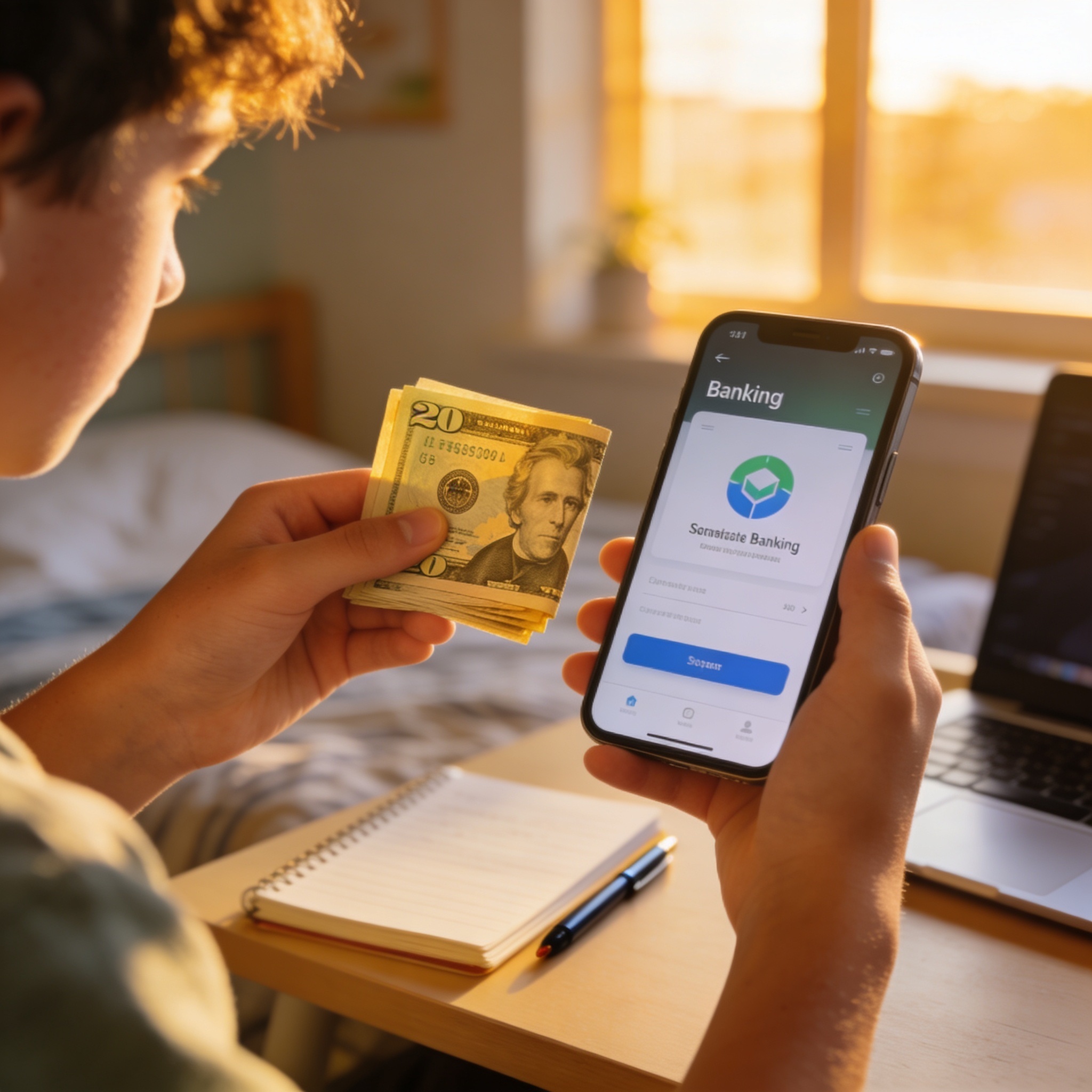

Why the First $1,000 Is a Critical Financial Milestone for Teens
The first $1,000 is rarely just about $1,000. It's a psychological threshold - the first time a teenager has accumulated enough money to make a meaningful choice about it. What they do with it will, more often than not, set a behavioral precedent that shapes how they handle money for years.
Research from the Consumer Financial Protection Bureau and multiple behavioral finance studies consistently shows that financial habits formed in adolescence are among the most durable of adult life. This isn't anecdote - it's the reason how a teenager handles their first significant savings moment matters enormously as a parenting opportunity.
How to Guide the Conversation Without Taking Over
This is the tension every parent of a financially awakening teenager feels: you want to help, but you also know that taking over erases the ownership that makes the lesson stick. The goal is to be a facilitator, not a director.
- Ask questions instead of giving instructions: "What are you thinking you want to do with it?" before offering your perspective
- Share options and tradeoffs, not mandates: "Here's what a HYSA does vs. a checking account - what makes more sense to you?"
- Let them make a small mistake if the stakes are manageable - spending $100 they shouldn't have and feeling it is more educational than a lecture
- Celebrate the milestone explicitly: hitting $1,000 in savings is a genuine achievement that most adults haven't reached. Name it as such.
The framing that tends to resonate most with teens: "This money is proof you can build wealth. What you do with it right now is what determines whether that's a one-time thing or a pattern."
Opening a High-Yield Savings Account for Teens
Most standard bank savings accounts pay somewhere between 0.01% and 0.5% APY - effectively nothing. In 2026, high-yield savings accounts at online banks are paying 4-5% APY on average, which means $1,000 earns $40-$50 per year just by existing in the right account. For teens just learning that money can work for them passively, this is a powerful and concrete demonstration.
Reputable HYSA options worth considering for teens (most require a parent to co-own the account for minors):
- Marcus by Goldman Sachs - competitive APY, no fees, highly rated for ease of use
- Ally Bank - consistently strong rates, excellent mobile experience, no minimum balance
- SoFi - strong rates, integrates savings and checking, easy to set up automated transfers
The process of opening an account together - filling out the application, linking a funding source, watching the first interest payment appear - is itself a teachable moment that no book or app can fully replicate.
Custodial Investment Accounts: Getting Teens Started Investing
Once an emergency cushion is established, introducing age-appropriate investing is the natural next step. For minors, this requires a custodial account - a brokerage account opened in a parent's name on behalf of the child, which transfers fully to the teen at age 18 (or 21, depending on state).
Well-regarded options for teen investors in 2026:
- Fidelity Youth Account - one of the best-designed teen investment accounts; teens 13-17 can open in their own name with parental oversight; no account minimums; access to fractional shares
- Acorns Early (formerly Acorns for Kids) - custodial investing with automated round-up contributions; good for teens learning investing passively
- Greenlight - combines debit card, savings goals, and a parent-supervised investing component in one app; well-designed for ages 13+
For a first investment, the recommendation from virtually every financial educator: keep it simple and broad. A low-cost S&P 500 index fund (like Fidelity's FZROX, Vanguard's VOO, or SPDR's SPY) is the appropriate starting point. The goal at this stage is not to maximize returns - it's to build the habit of investing and develop comfort with how markets work.
What to Do Based on Where the Money Came From
From a First Job or Regular Work
This is the ideal scenario. The money came from effort, which means they already have a working understanding of earning. Focus the conversation on automating a split before lifestyle inflation kicks in - get the savings and investment transfer set up on the same day as payday, before the money ever sits in a checking account.
From Birthday Gifts or Accumulated Savings
The windfall psychology is different. Money that arrived without effort has less psychological weight and is more vulnerable to impulsive spending. Add a deliberate pause - the 48-hour rule is valuable here - and have an explicit conversation about what this represents before any decisions are made.
From an Inheritance or Estate Gift
This requires the most care. Inherited money often arrives with emotional context that complicates pure financial decision-making. Acknowledge the emotional dimension first, then approach the financial decisions slowly and deliberately. This is also a situation where working with a fee-only financial advisor may be worth considering.
From Selling Things or a Side Hustle
Entrepreneurial income at a young age is worth treating as a distinct category. These teens are already demonstrating financial initiative - the conversation can go further faster, including discussions of reinvesting earnings, tracking business income vs. personal income, and even foundational concepts around self-employment taxes.
The Lifestyle Creep Warning: Earn More, Spend More
Lifestyle creep is the phenomenon where spending rises to match income - and it's just as dangerous for teens as for adults. A teenager who earns $200 from a first job and immediately upgrades their spending on food, clothing, and entertainment to absorb most of that income has learned the wrong lesson from employment.
The intervention: establish savings automation before the first paycheck arrives. When the transfer to savings is set up in advance, the money never sits in the spending account waiting to be absorbed. This is, in fact, how most financially successful adults manage their behavior - they don't rely on willpower, they design systems that make the right choice automatic.
- Set up automatic transfers to the HYSA on payday - before any other spending happens
- Keep investment contributions automatic - even $25/month at 16 has substantial long-term impact
- Discuss income increases explicitly: "You earned $50 more this month - where does that extra go?"
The Roth IRA Opportunity for Teens With Earned Income
This is one of the most underutilized financial tools available to working teens - and one of the most powerful. A Roth IRA allows after-tax contributions to grow completely tax-free, with qualified withdrawals in retirement also tax-free. For a teenager in a low or zero tax bracket, the math is exceptional.
Key rules as of 2026: contributions cannot exceed annual earned income, and cannot exceed the annual IRS limit (currently $7,000/year). A custodial Roth IRA can be opened by a parent for a minor with any earned income - even from babysitting, mowing lawns, or a part-time job.
The compound interest case for a teen Roth IRA: $1,000 contributed at age 16 in a Roth IRA, invested in a broad index fund at an average 10% annual return, grows to approximately $45,000 by age 56 - completely tax-free. Add consistent annual contributions and the number becomes life-changing. Few financial decisions a parent can help a teenager make will have a greater long-term impact.
No additional contributions. $44,259 earned on a $1,000 investment made as a teenager. This is why starting early matters more than starting with more money.
Join Young Bucks Club - Free
Young Bucks Club gives teens 13-18 the tools to set financial milestones, track savings, learn about investing, and build the habits that most adults wish they'd started earlier - all free to join.
Join Free - No Credit Card →