What Every Parent Needs to Know About a Kids Saving Challenge

Most kids don't have a saving problem. They have a starting problem. In 2026, with most family spending happening invisibly through tap-to-pay and one-click checkouts, the act of dropping a single coin into a jar has quietly become one of the most powerful money lessons a kid can experience. A 30-day kids saving challenge isn't about the dollar amount at the end - it's about turning saving from an idea into a daily, physical, can't-miss habit.
Key things to know:
- Habit research shows it takes around 21-66 days for a behavior to feel automatic - 30 days lands squarely in the sweet spot for a child's first money habit.
- The total amount saved is almost never the point. The repetition is the point.
- Daily contributions beat weekly ones for kids ages 6-10 - small touches every day build the neural pattern faster.
- A clear visual finish line (a marked jar, a calendar, a goal taped to the wall) doubles completion rates in family-tested versions.
- Kids quit when the challenge feels like a chore - keep the daily ritual under 60 seconds.
- Letting your kid pick their own end-of-challenge reward is the single biggest predictor of finishing all 30 days.
Core considerations before you start:
- Decide the funding source before day one - pocket change you'd otherwise lose? A penny match for every coin they add? A weekly allowance split?
- Pick a jar your kid can see through. Opaque containers cut motivation in half because the progress is invisible.
- Pick a daily time anchor - right after dinner, right before bed, right after the school bus drops off. Same time, every day.
- Decide what happens on weekends and trip days in advance, not in the moment when motivation dips.
- Choose a reward that costs less than the savings goal so the math actually teaches something.
Done right, the coin jar challenge gives your child their first real experience of seeing their own behavior produce a result - and that lesson outlasts every dollar in the jar by years.
Young Bucks Club helps families build money confidence with no-jargon guides and a free budgeting app. In this guide, we'll walk you through the four challenge styles to choose from, the daily ritual that keeps kids engaged, and the week-by-week roadmap parents have used to actually finish all 30 days.
The Four Styles of Kids Saving Challenges
Not every saving challenge works for every kid. A 6-year-old needs something tactile and immediate. A 10-year-old wants a number on a chart they can beat. A 12-year-old will tune out anything that feels babyish. The good news is the family of "coin jar" challenges has variations for each age - and picking the right one matters more than the rules themselves.
Recent parenting surveys in 2026 show that money-focused habit challenges with daily prompts have roughly double the completion rate of open-ended "just try to save" goals. The structure isn't a constraint - it's the whole reason these challenges work for kids whose brains aren't yet built for abstract long-term planning.

The Classic Coin Jar Challenge
The original. One jar, one daily coin, 30 days, one reward at the end. It is dead simple and that's the entire point. The classic version is the best entry point for kids who have never followed through on anything resembling a savings habit before.
- Effort: About 30 seconds per day, including the conversation around it
- Total saved: Anywhere from $3 to $30 depending on coin choice and matching
- Best age range: 6-9 - old enough to handle coins, young enough to find the ritual itself magical
- Risk: Plateaus around day 12 if there's no streak count or visible milestone
If your kid is younger or has never finished anything resembling a 30-day goal, start here. Do not overcomplicate it. The win is the streak, not the total.
The Escalating Coin Challenge
This is the version that takes off on social media every January. Day 1 you add 1 cent. Day 2 you add 2 cents. Day 30 you add 30 cents. Total at the end: $4.65. The math itself becomes the lesson, and kids 8 and up love the rising challenge.
In 2026, a version of this challenge using dollars instead of cents - starting at $1 and topping out at $30 on day 30, ending around $465 - has been getting traction among older teens. Same mechanic, different scale, same brain-building. The escalation creates a built-in story your kid can tell: "today was day 22, so I added 22 cents."
The escalation also gives you a natural conversation about what's happening - the same daily action gets harder, but feels normal because they did slightly less yesterday. That's the foundation of how habits compound. Most adults never learn it.
How to Choose the Right Coin Jar Challenge for Your Kid
Use this comparison to pick the version that fits your kid's age, attention span, and your family's budget for matching. There's no wrong answer - but there is a wrong fit, and a too-ambitious challenge that ends on day 8 teaches kids the opposite of what you want.
| Challenge | Daily Effort | 30-Day Total | Best For |
|---|---|---|---|
| Classic Coin Jar | 1 coin per day | $3-$30 | Ages 6-9, first-timers |
| Escalating Penny | Day # in cents | $4.65 | Ages 8-11, math-curious kids |
| Match-a-Coin | Kid + parent each add 1 coin | $6-$60 | Ages 6-12, families wanting a bigger payoff |
| Round-Up Jar | Drop in coins from every purchase | $15-$50 | Ages 9-12, families that still use cash |
| Chore-Linked Jar | Earn coins by completing chores | $10-$45 | Ages 7-12, kids motivated by earning |
Expert tip: If you're not sure, default to Match-a-Coin. The act of you adding a coin alongside your kid every single day creates a shared ritual, and shared rituals are the stickiest behavioral glue in family habit research. The matching also turns the jar into something the family is building together, which keeps your kid coming back even on the days they don't really feel like it.
What if my kid gives up around day 10?
This is the most common drop-off point - the novelty has worn off and the finish line still feels far away. Try these in order:
- Add a visible streak counter. Tape a 30-day grid to the wall behind the jar. Every successful day gets a sticker. The empty squares become a problem your kid wants to solve.
- Increase the size of the daily contribution by 2x for one week. The jumping-up of progress in the jar gives a visible reset.
- Add a "no-spend day" bonus - every day your kid passes up something they wanted to buy, they drop an extra quarter in. This converts willpower into a measurable win.
- Set a mid-challenge mini-goal at day 15 - a $2 ice cream, a movie night, anything cheap. Two finish lines beats one finish line every time.
If you want a longer playbook on what to do when daily habits stall, our guide on 7 fun ways to make saving exciting for kids has seven additional approaches that pair well with the coin jar.
Cash-Only vs. App-Tracked Challenges
A cash-only challenge - real coins in a real jar - wins every single time for kids ages 6-9. The weight of the jar getting heavier, the sound of coins dropping in, the visual fill level - none of that can be replicated digitally for a younger brain. The physical feedback is the lesson.
For kids 10 and up, a hybrid model works well: keep the physical jar for the daily ritual, but mirror the total in a kid-friendly savings app like BuckBook so they start connecting the physical world of money to the digital one. By age 12, most kids are ready for the app to lead and the jar to fade into a fun bonus.
The Coin Jar Challenge for Every Stage of Childhood
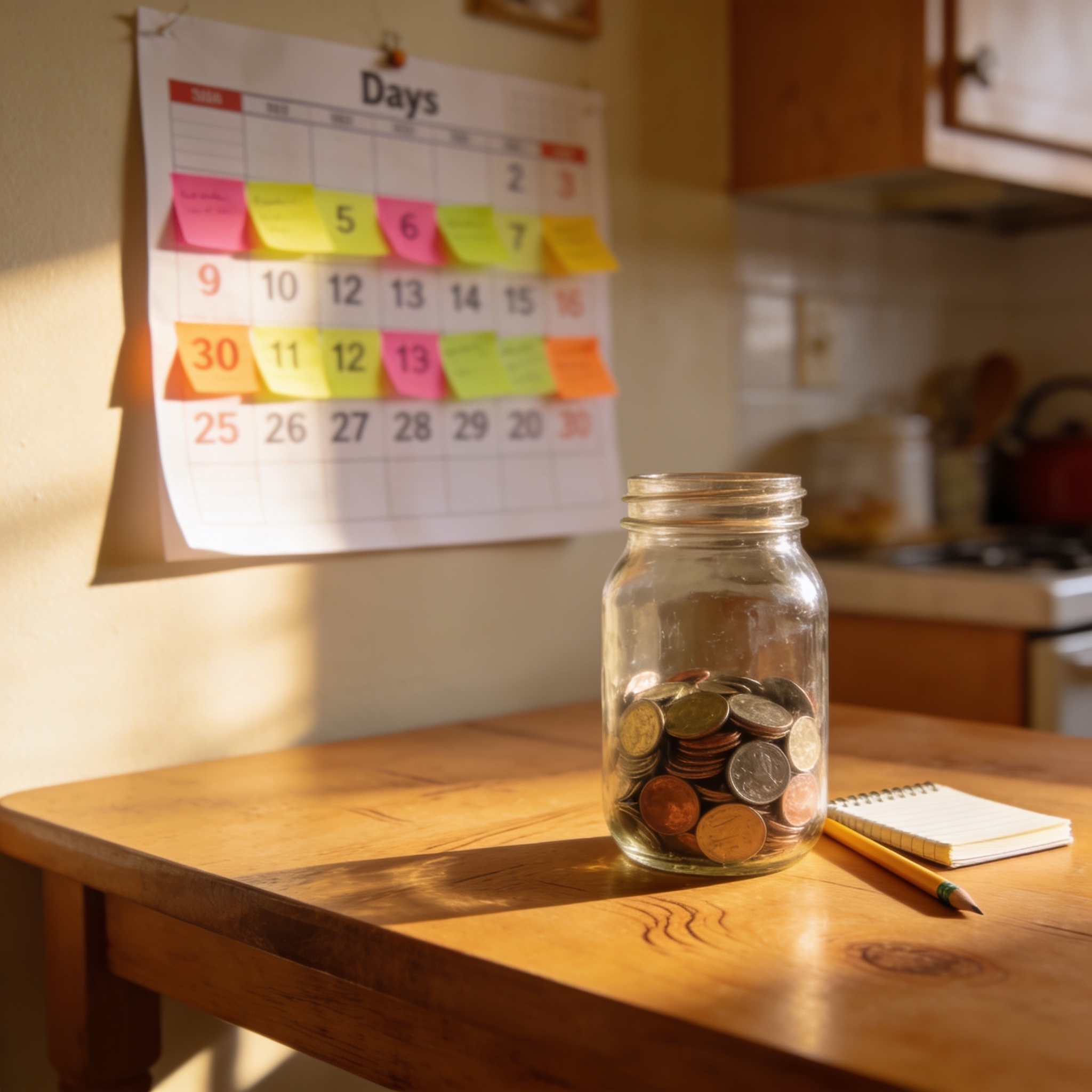
A 6-year-old, a 9-year-old, and a 12-year-old can technically all do the "same" challenge - but the framing, the reward, and the conversation around it should be wildly different. Here's how the same jar works in three different living rooms:
- Ages 6-7 (sensory stage): The challenge is the ritual itself. The "reward" is the satisfaction of dropping the coin in and counting the streak on a sticker chart. The total at the end is almost beside the point. Keep the daily window under 30 seconds and end on a high.
- Ages 8-10 (goal stage): Now the reward starts to matter. Kids this age can hold a specific goal in their head for 30 days - a video game, a new Lego set, a special outing. Tape a picture of the goal to the jar. The brain treats the picture like part of the goal.
- Ages 11-12 (autonomy stage): The challenge becomes about ownership. Let your tween design their own version, set their own rules, and decide their own reward. Your job is to fund a match and stay out of the way. Heavy parent involvement at this age kills motivation faster than anything else.
Three Reward Tiers (Beginner, Intermediate, Advanced)
- Beginner ($5-$10 reward): A movie night, a special trip to the bakery, a small toy from the dollar store. Keep the cost lower than the amount saved so the math is obviously a win.
- Intermediate ($15-$30 reward): A small toy or book your kid has been asking about for weeks. Have them pay for some of it from the jar - even just half - so the trade-off becomes real.
- Advanced ($30+ reward): A bigger item that requires the full amount saved plus a parent match. This is where you can demonstrate compound effort - they saved, you matched, now they can afford something that felt out of reach 30 days ago.
Customizing the Challenge to Your Family in 2026
In 2026, the majority of family spending happens through cards, apps, and tap-to-pay. That makes a physical coin jar both harder to fund and more valuable - because it's one of the few places your kid can actually see money exist as a tangible thing. Try one of these three adjustments to fit modern family life:
- The Cash-Back Jar: Every time you get a cashback reward or rebate, the physical-dollar equivalent goes in your kid's jar. Turns invisible money into visible money.
- The Subscription Skip: Once a month, cancel a small subscription you forgot about. That month's $5 or $10 goes in the jar. Your kid learns "where money goes" in real time.
- The Round-Down Game: Every time you pay for something in cash, the change rounded down goes in the jar - you'd never miss it, and your kid sees how small amounts add up.
Why Young Bucks Club Makes a Difference

If you've ever started one of these challenges with great energy and watched it quietly fizzle out by week two, you're in the majority. Most families don't fail because the challenge was bad - they fail because there's no clean way to track progress, no place to log the streak, and no next-step waiting after day 30. The jar finishes and nothing replaces it.
- BuckBook is free - the kid-friendly app that mirrors the physical jar, tracks the streak, and shows progress toward a goal. No paywall, no premium tier games.
- No ads to kids - kids never see a single ad inside BuckBook, period. Family money habits don't belong next to a toy commercial.
- Kid-friendly UI - designed for a 9-year-old to use without you sitting next to them. Big buttons, no jargon, fun visuals when they hit a streak milestone.
- Family-account sync - you can see what your kid is doing, match contributions from your phone, and celebrate the streaks together without having to be in the same room.
Getting the Most Out of the Coin Jar Challenge
- Pick the daily time anchor before day one and don't change it. "Right after dinner" beats "sometime today" 100% of the time.
- Make the jar visible - kitchen counter, dining table, somewhere it gets walked past at least 5 times a day. Out of sight is out of mind, and out of mind is dead by day 6.
- Celebrate the streak weekly. A sentence is enough - "you've done this 7 days in a row" - but skipping it removes 80% of the dopamine that's keeping the habit alive.
- Plan round two before round one ends. Day 31 should already have a new goal taped to the jar. Habits that stop end. Habits that flow into the next thing become permanent.
When you're ready for the digital piece - or just want a place to track your kid's progress without the sticker chart - BuckBook is free at app.youngbucks.club and built for exactly this transition.
Frequently Asked Questions About the Coin Jar Challenge
What if we miss a day in the coin jar challenge?
Don't restart the count - that punishes the kid for being human and almost always ends the challenge. Instead, drop in a "make-up coin" the next day and move on. Habit research is clear: missing one day has almost no effect on long-term habit formation. Missing two in a row starts to matter - so the rule is, never miss two days back to back.
Is the coin jar challenge worth doing if my kid already gets allowance?
Yes - they're solving different problems. Allowance teaches budgeting and trade-offs across a week or month. The coin jar challenge teaches daily repetition and the feeling of progress. A kid can do both, and the daily ritual of the jar actually reinforces the allowance habit by making "saving" a thing that happens every day, not just once a week. Pair it with the system in our 3-jar method guide for a complete starter setup.
How much money does my kid actually save in a 30-day coin jar challenge?
Between roughly $5 and $50, depending on the version you pick and whether you're matching their contributions. But the dollar total is the smallest benefit of the challenge - what your kid is really building is the muscle of "I can stick with something for 30 days," and that skill compounds for the rest of their life. The money is a souvenir, not the prize.
Conclusion
The coin jar challenge is small on purpose. The point isn't the $20 in the jar on day 30 - it's the kid who, for the first time in their short life, started something and finished it. That's the real win, and once your kid has felt it once, they will chase that feeling again. Money becomes the easiest place in life to practice it because the feedback is so visible. A heavier jar today than yesterday. A streak that's still alive. A goal getting closer. These are not small lessons. These are the seeds of every adult financial habit they will ever build.
If you want a kid-friendly place to track the streak, set the goal, and let your child watch their progress without losing the jar's magic, join Young Bucks Club free and we'll send you the printable 30-day tracker plus weekly prompts to keep the challenge going. Round one starts whenever you say it does.
Join Young Bucks Club - Free
Get the printable Coin Jar Challenge tracker, weekly prompts, and our free guide to building the next money habit after day 30.
Join Free - No Credit Card →